The 80/20 Training Rule: Why Elite Athletes Spend 80% of Their Time Jogging
A Counterintuitive Discovery
If you observe training in Kenyan running camps or track the daily routines of world-class marathoners, you'll notice a surprising phenomenon: most of the time, they run much slower than you'd imagine.
This isn't slacking off. This is science.
Norwegian sports physiologist Stephen Seiler conducted decades-long research on elite athletes across various endurance sports (running, cycling, cross-country skiing, rowing) and reached a consistent conclusion:
Top endurance athletes spend about 80% of their training time at low intensity, with only 20% dedicated to high-intensity training.
This is the famous 80/20 Training Rule, also known as the Polarized Training Model.
Why Do We Always Train Too Fast?
Seiler's research reveals an interesting phenomenon: the training intensity distribution of recreational runners is vastly different from that of elite athletes.
- Elite athletes: 77% low intensity, 3% moderate intensity, 20% high intensity
- Recreational runners: 45.8% low intensity, 45.7% moderate intensity, 8.9% high intensity
As you can see, recreational runners spend a significant amount of time in moderate intensity—that awkward zone that's neither easy enough to build an aerobic base nor hard enough to stimulate breakthroughs. This is called the moderate-intensity trap.
Scientific Evidence: Why Does 80/20 Work?
1. The Salzburg Study: Polarized Training Wins
A classic study divided trained runners into three groups for 9 weeks of training:
- Polarized training group (77/3/20): ran 32 minutes daily
- High-intensity training group (40/50/10): ran 27 minutes daily
- Threshold training group: primarily moderate intensity
The results showed: the polarized training group achieved the most significant improvements in VO2 max and time trial performance. Even when accounting for differences in total training volume, the polarized approach outperformed other distributions.
2. Esteve-Lanao et al. (2007) Study
This study assigned recreational runners to train with different intensity distributions for 10K races, finding that runners following the 80/20 model achieved greater improvements than those inclined toward high-intensity training.
3. Stöggl & Sperlich (2014) Meta-Analysis
After synthesizing multiple studies, they confirmed that for improving VO2 max, time to exhaustion, and race times, polarized training is superior to threshold and high-volume training.
Physiological Mechanisms: Why Does Slow Make You Faster?
What Does Low-Intensity Training (That 80%) Do?
- Mitochondrial biogenesis: Prolonged low-intensity exercise stimulates mitochondrial generation, increasing the number of cellular power plants
- Capillary expansion: Promotes angiogenesis, improving oxygen and nutrient delivery efficiency
- Fat oxidation capacity: Enhances the body's ability to use fat as fuel, sparing glycogen reserves
- Active recovery: Promotes metabolic waste clearance and improves heart rate variability (HRV)
- Fatigue resistance: Long slow runs build tolerance for suffering
What Does High-Intensity Training (That 20%) Do?
- Stimulates type II muscle fibers: Recruits fast-twitch fibers, improving explosive power
- Increases VO₂max: Raises the ceiling of your cardiopulmonary system
- Neuromuscular adaptation: Improves running economy
- Race-specific preparation: Allows your body to adapt to race intensity
Why Is Moderate Intensity Junk Miles?
The problem with moderate-intensity training (like continuous threshold runs) is:
- Fast fatigue accumulation: High recovery demands prevent maintaining high training volume
- Insufficient stimulus: Not strong enough to trigger significant adaptive changes
- Inadequate recovery: Affects the quality of the next training session
As Dr. Seiler said in his TEDx talk: NO PAIN NO GAIN is a misleading slogan. Overemphasizing moderate intensity leads to fatigue accumulation and inadequate recovery, which actually reduces performance.
How to Practice 80/20 in PaceGuru?
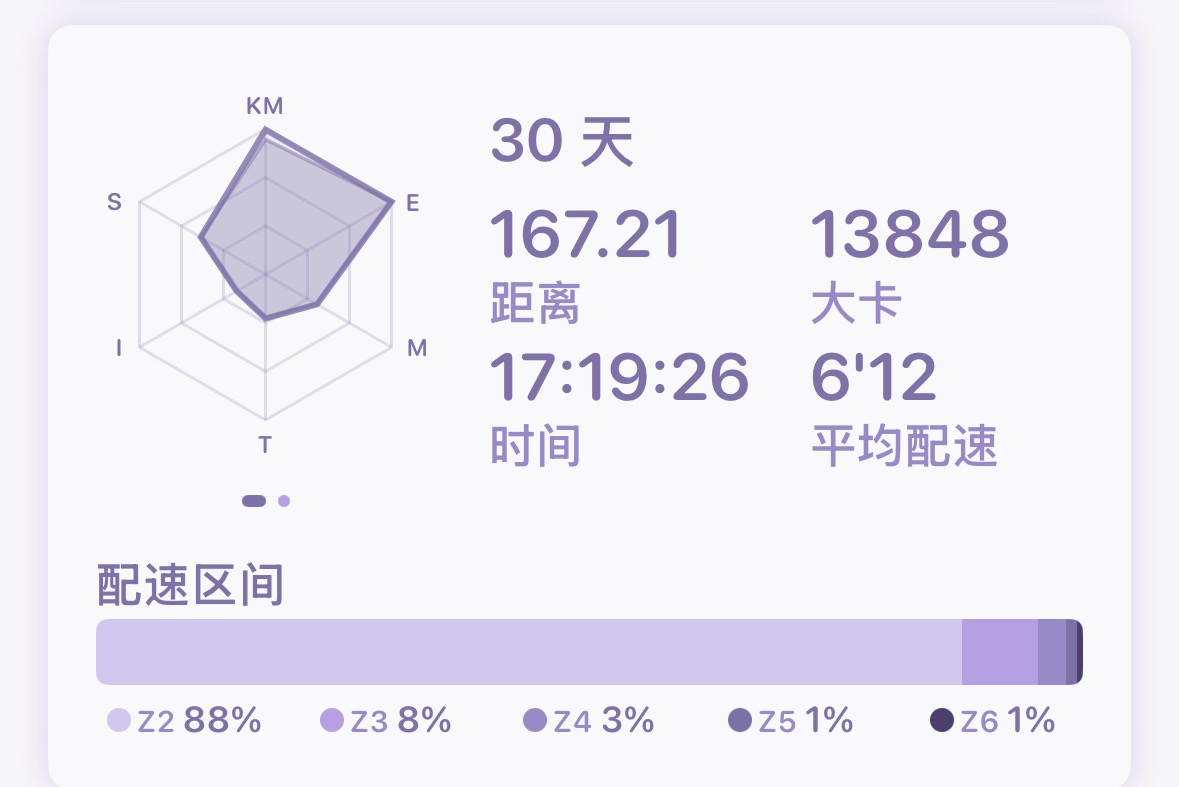
PaceGuru's hexagonal ability radar chart is designed for this. You can:
- Set zone percentage targets: Set easy runs (Zone 1-2) to about 75-80%
- Track 30-day training distribution: See if your actual training matches targets
- Balance weekly schedule: Ensure 1-2 high-quality sessions, with the rest being easy runs
Typical Week Structure (5 runs/week)
- Tuesday: Interval runs or speed training (high intensity)
- Thursday: Tempo runs or threshold runs (medium-high intensity)
- Saturday: LSD long run (low intensity, focus on duration)
- Monday, Friday: Easy recovery runs (low intensity)
Conclusion
Training doesn't have to be exhausting every time. Science tells us: to run fast, you must first spend a lot of time running slow.
As Kenyan runners demonstrate, real progress comes from patience—during those seemingly easy but critically important slow jogs, your body is quietly undergoing changes.
The next time you want to speed up your easy run, remember: slow down to go faster.
#PaceGuru #80/20TrainingRule #ScienceRunning #PolarizedTraining